Commercial Roof Inspection Guide for Building Owners (2026)
Written by Marc D., GCT Expert Analyst · Updated July 2026 · 6 min read
Commercial and industrial roofs fail on a predictable schedule when inspections are skipped. Here is the full inspection framework for flat and membrane systems — with the maintenance cadence, insurance triggers and budget model that keep a 20-year roof lasting 25.
Direct answer
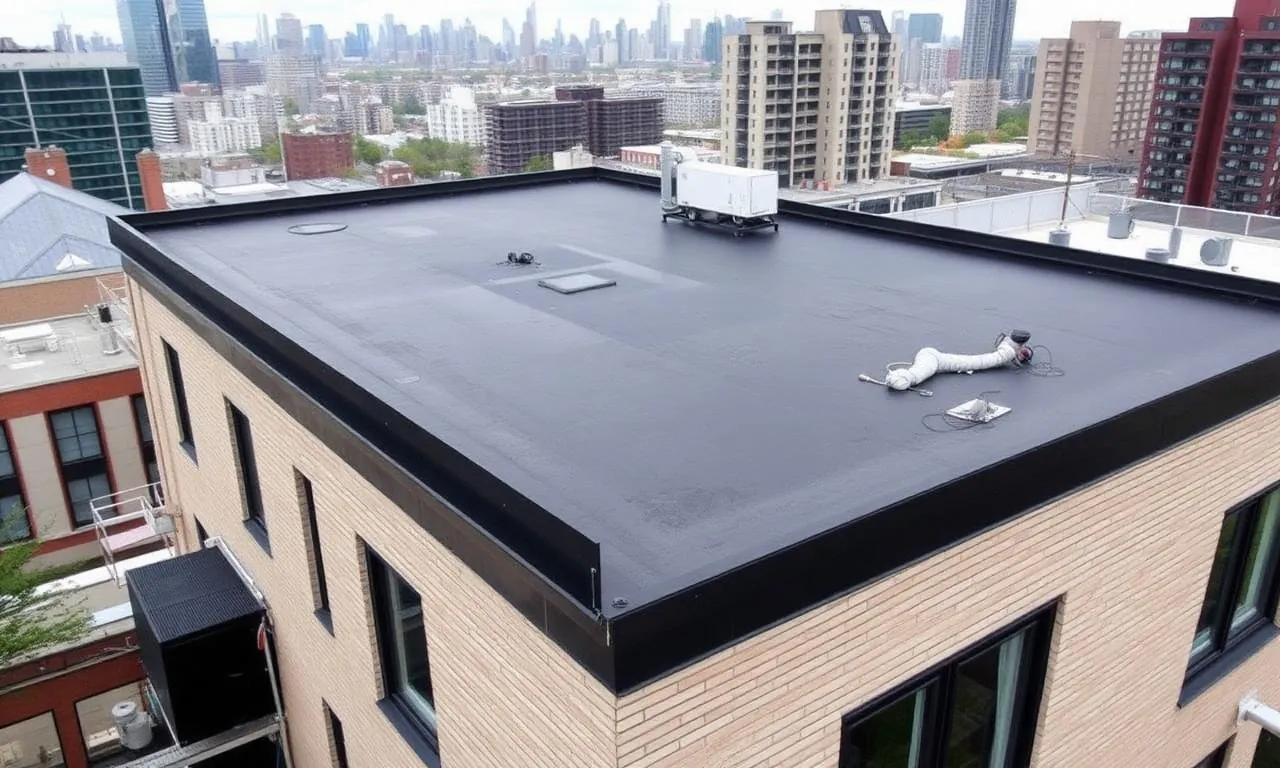
A commercial or industrial roof should be inspected twice a year — spring and fall — plus after any severe weather event. A single skipped inspection typically shortens roof life by 3 to 7 years and multiplies repair cost by 3 to 10x once water reaches the insulation. This guide covers flat and membrane systems (TPO, EPDM, modified bitumen, PVC), preventive maintenance cadence, insurance-driven inspection triggers, and how to build a defensible capital plan.
Why Commercial Roofs Fail Differently
A residential shingle roof leaks slowly at a visible spot. A commercial flat roof:
- Ponds water for days after each rain, softening seams and drains.
- Traps moisture in the insulation long before ceiling stains appear.
- Punctures easily during HVAC service, snow removal or window cleaning.
- Fails at the details (drains, curbs, parapets) far more often than in the field.
- Amplifies deferred maintenance — a $200 seam repair skipped in year 7 becomes $40,000 in tear-off and replacement in year 12.
The Semi-Annual Commercial Inspection Framework
Field of the Roof — 8 checks
- Membrane surface — blisters, ridges, alligatoring, granule loss (modified bitumen)
- Seam integrity — probe every welded or adhered seam with a rounded pick
- Ponding water — mark areas holding water 48 hours after rainfall
- Punctures, tears, foot traffic damage, dropped tools
- UV degradation (chalking on PVC, hardening on EPDM)
- Insulation compression under high-traffic paths
- Ballast displacement (if EPDM ballasted system)
- Cover board condition through core cuts (every 5 years)
Perimeter and Parapets — 6 checks
- Coping cap fasteners, joints and slope toward the roof
- Termination bar integrity and sealant condition
- Parapet flashings — reglets, counterflashing, expansion joints
- Wall-to-roof transitions and returns
- Scupper and overflow scupper condition
- Exterior wall staining below the coping (indicator of coping failure)
Drains and Waterways — 6 checks
- Primary drain clamping rings tight and clean
- Strainer baskets present and unobstructed
- Secondary (overflow) drains functional
- Drain sumps free of debris
- Membrane properly heat-welded or stripped-in to the drain flange
- Interior drain leader inspection at ceiling level (staining, corrosion)
Penetrations and Equipment — 8 checks
- HVAC curbs — flashing height min. 8 in above finished roof
- Pipe boots and pitch pans (pitch pans must be filled and topped every 2-3 years)
- Gas line supports (rubber pads, no direct contact with membrane)
- Electrical conduit and satellite mounts
- Skylight curbs, condensation gutters, glazing seals
- Roof hatches — sealant, hinges, insulation
- Exhaust fan units — bearings, belts, curb integrity
- Snow guards and lightning protection anchors
Safety and Access — 4 checks
- Roof access ladder or hatch code compliance
- Anchor points for fall-arrest tie-off (annual load test)
- Guardrails at leading edges (OHSA / CNESST requirement in most cases)
- Warning line systems around skylights and openings
Preventive Maintenance Cadence
| Task | Frequency | Approx. cost |
|---|---|---|
| Semi-annual inspection with photo report | 2x per year | $400 – $1,200 per visit |
| Debris clearing and drain cleaning | Quarterly | $200 – $600 |
| Sealant renewal at metal edges and penetrations | Annually | $500 – $2,000 |
| Pitch pan refilling | Every 2-3 yrs | $150 – $400 per pan |
| Membrane wash (PVC/TPO) | Every 3-5 yrs | $0.05 – $0.15 per sq ft |
| Coring / moisture survey | Every 5 yrs | $0.10 – $0.35 per sq ft |
| Infrared or capacitance moisture scan | Every 5-8 yrs | $0.05 – $0.20 per sq ft |
A proper preventive program costs $0.08 to $0.20 per sq ft per year and defers replacement by 5 to 10 years on a well-installed membrane.
Insurance-Driven Inspection Triggers
Property insurers now require documented roof inspections at renewal for:
- Buildings over 20 years old or with roofs over 15 years old
- Post-storm inspections after hail, wind above 90 km/h, or heavy snow load
- Any prior water-damage claim on the property
- Restaurants, condos and multi-tenant buildings above a threshold value
- Warehouses with high-value inventory below the roof
A missing or expired inspection report is one of the fastest ways to have coverage denied on a leak claim. Keep every report on file for at least 10 years.
Membrane Systems and Their Failure Points
| System | Typical life | Common failures | Best-fit use |
|---|---|---|---|
| Modified bitumen (SBS, torch-applied) | 25-35 yrs | Blistering, granule loss, seam pull-back | Quebec residential-commercial, condos |
| TPO (thermoplastic olefin) | 20-30 yrs | Seam separation, weathering | Warehouses, retail, big-box |
| EPDM (rubber) | 25-40 yrs | Shrinkage, seam failure, punctures | Older commercial, low-traffic roofs |
| PVC | 25-30 yrs | Plasticizer migration, curb failures | Restaurants, industrial with grease exposure |
| Built-up (BUR) | 20-30 yrs | Alligatoring, blisters, brittle field | Legacy roofs, industrial |
| Metal (standing seam) | 40-60 yrs | Fastener back-out, sealant fatigue | Industrial, agricultural |
Annual Inspection Schedule Template
- March / April: Post-winter inspection — snow load damage, ice damming, sealant checks, drain clearing.
- September / October: Pre-winter inspection — punctures from summer traffic, HVAC service damage, drain and scupper priming.
- Post-event: Within 48 hours of hail, wind gust over 90 km/h, or accumulation over 24 in of wet snow.
- Pre-warranty expiry: 60 days before manufacturer warranty ends, so any claim can be filed in time.
Budget Planning for a Commercial Roof
Model roof cost as a per-sq-ft annual capital reserve:
| Roof age | Annual reserve per sq ft |
|---|---|
| 0 – 5 yrs | $0.05 – $0.10 |
| 5 – 15 yrs | $0.15 – $0.30 |
| 15 – 20 yrs | $0.40 – $0.75 |
| Approaching end of life | $1.00 – $1.75 |
On a 20,000 sq ft warehouse, a 15-year-old TPO roof carries a reasonable reserve of $3,000 to $6,000 per year. Replacement will typically land at $180,000 to $340,000 including insulation and cover board upgrades.
Commercial Roofing Standards Worth Knowing
- CRCA (Canadian Roofing Contractors Association) guidelines
- RCAT / RCABC in western Canada
- NRCA (National Roofing Contractors Association) — U.S. reference used across Canada
- CAN/CSA A123 series (asphalt shingles, membrane systems)
- ULC S107 fire tests for roof coverings
- CAN/CSA A440.4 for skylights
- Quebec: Code de construction du Québec, Chapitre I
- Ontario: OBC SB-12 for insulation and vapour control
References to these standards should appear in any legitimate commercial specification.
When to Move from Inspection to Replacement
Replace rather than repair when:
- More than 25% of the roof area shows moisture through core cuts or IR scan
- Repeat leaks in the same area despite two prior repairs
- Insulation R-value has dropped by 30%+ due to saturation
- Membrane is beyond 80% of manufacturer's rated life
- Replacement cost falls below 5 years of accumulated repair spend
FAQ — Commercial roof inspection
How often should a commercial roof be inspected?
Twice per year (spring and fall), plus after any storm event. Insurers may require additional inspections for older roofs at policy renewal.
What does a commercial roof inspection cost?
$400 to $1,200 per visit depending on roof size, complexity and access. Moisture surveys and core cuts run $0.05 to $0.35 per sq ft.
Can our facilities manager do the inspection?
Only for interim visual checks. Warranty-grade and insurance-grade inspections require a qualified third-party inspector or the manufacturer's field technician.
Does regular inspection keep the manufacturer warranty valid?
Yes. Most 20-year commercial membrane warranties require documented inspections and repair records; missing records is the most common reason claims are denied.
How do we choose between repair and replacement?
Use the 25% moisture rule, the repeat-leak rule and the 5-year cost model above. A specialized third-party review is worth its cost on any decision over $50,000.
Received a roofing quote?
Have your quote reviewed before signing. GCT Expert helps Québec homeowners better understand prices, contracts and risks tied to roofing work.
Review my quote